Best Exterior Cladding Options: A Deep Technical & Editorial Guide
The building envelope is the primary line of defense against environmental degradation and the most significant contributor to a structure’s architectural identity. Choosing a cladding system is not merely an aesthetic exercise; it is a complex engineering decision that balances hydrothermal performance, structural integrity, and life-cycle economics. Best Exterior Cladding Options. As urban environments face increasing climatic variability—ranging from extreme heat islands to intensified precipitation—the selection of an exterior skin dictates the long-term viability of the asset.
In professional practice, the concept of performance extends beyond the material’s surface. It encompasses the internal drainage planes, the integrity of the vapor barriers, and the thermal bridges created by attachment hardware. A failure in any of these sub-systems can render the most expensive material choice obsolete, leading to systemic moisture intrusion or catastrophic energy loss. Consequently, the discourse surrounding building exteriors has moved away from purely stylistic preferences toward a systems-thinking approach.
The following analysis serves as an exhaustive reference for the technical and practical nuances of contemporary building skins. It avoids the reductive “top ten” lists common in mainstream media, focusing instead on the mechanical logic and contextual appropriateness required for high-stakes architectural projects. We will examine the materials, the physics of the wall assembly, and the economic variables that define the current state of the industry.
Understanding “best exterior cladding options”
The search for the best exterior cladding options is frequently undermined by a lack of contextual specificity. There is no singular “best” material in a vacuum; there is only the most appropriate system for a specific micro-climate, building height, and maintenance budget. One of the most common oversimplifications is the tendency to prioritize the R-value of the insulation behind the cladding while ignoring the U-factor of the entire assembly, which accounts for the thermal bridging caused by metal furring strips or brick ties.
A sophisticated understanding requires viewing the cladding as part of a “rainscreen” principle. This approach assumes that the exterior skin will eventually leak. Rather than attempting to create a perfectly waterproof barrier—which inevitably fails due to UV degradation and structural settling—the most effective plans utilize a ventilated cavity. This allows moisture to drain away and air to circulate, drying the assembly from the inside out. When stakeholders debate the “best” options, they often focus on the cladding panel itself, neglecting the critical role of the air-weather barrier (AWB) and the flashing details that actually keep the building dry.
Furthermore, the “best” choice is often a moving target dictated by local building codes and fire safety regulations. Following tragedies like the Grenfell Tower fire, the industry has undergone a radical shift in how it evaluates Aluminum Composite Materials (ACM) and high-pressure laminates. What was considered a premier option a decade ago may now be restricted based on the building’s proximity to property lines or its total height, making regulatory compliance a primary filter for selection.
Deep Contextual Background: From Mass to Membrane
Historically, building exteriors relied on “mass walls”—thick layers of stone, brick, or adobe that absorbed moisture during rain and released it during dry periods. These walls were structural, carrying the weight of the roof and floors. The inherent thickness provided thermal mass, slowing the transfer of heat. However, the advent of the steel and concrete skeletal frame in the late 19th century decoupled the “skin” from the “bones.”
This separation birthed the “curtain wall” and the thin-cladding systems we use today. While these modern membranes allow for lighter, taller, and more expressive buildings, they lack the forgiving nature of mass masonry. Modern assemblies are high-performance but fragile; a single tear in a thin polyethylene wrap can cause significant rot in a way that a damp brick wall never would. We have moved from a period of “robust simplicity” to “engineered complexity,” where the cladding is now expected to be a lightweight, rain-deflecting, fire-resistant, and aesthetically perfect shield.
Conceptual Frameworks and Mental Models
To evaluate building skins effectively, professionals use specific frameworks that move beyond cost-per-square-foot.
-
The Hygrothermal Balance: This model treats the wall as a biological membrane. It asks: Where is the dew point? If warm, moist interior air hits a cold exterior cladding and condenses, the system is a failure regardless of its beauty. The cladding must be chosen based on its ability to allow the wall assembly to “breathe” or to keep the dew point within the insulation layer.
-
The 50-Year Horizon: This is a lifecycle assessment framework. A cheap vinyl or EIFS (Exterior Insulation and Finish System) may have a low entry cost but requires replacement or significant repair every 15 years. A high-end stone or zinc facade might last 80 years with minimal intervention. The “best” option is the one where the Net Present Value (NPV) of maintenance and replacement is lowest over the building’s life.
-
The Attachment-to-Weight Ratio: This framework evaluates the structural load the cladding places on the building’s frame. Heavy materials like natural stone or pre-cast concrete require significant structural steel, which increases the building’s embodied carbon. Lightweight options like fiber cement or metal panels allow for a leaner structural frame.
Key Categories and Material Variations
The following table summarizes the performance profiles of the most prominent systems currently in use.
| Material Category | Life Expectancy | Maintenance Needs | Primary Trade-off |
| Fiber Cement | 30–50 Years | Moderate (Painting) | Brittle; requires precise flashing |
| Metal (Zinc/Copper) | 80–100+ Years | Low (Patina) | High upfront cost; technical install |
| Natural Stone | 100+ Years | Low (Joint sealing) | Extreme weight; structural cost |
| Engineered Wood | 20–30 Years | High (Refinishing) | Susceptible to moisture if neglected |
| UHPC Panels | 60–80 Years | Very Low | High cost; specialized manufacturing |
| Brick Masonry | 100+ Years | Low (Repointing) | Labor intensive; slow installation |
Analysis of Decision Logic
Choosing among the best exterior cladding options usually involves a “triangulation” of three factors: local labor expertise, climate-induced stress, and fire-rating requirements. For example, in a high-wind coastal environment, a “lap” siding like fiber cement might be vulnerable to wind-driven rain being forced upward under the laps. A flat, interlocking metal panel system with a concealed fastener would be a more resilient, albeit more expensive, choice.
Detailed Real-World Scenarios Best Exterior Cladding Options
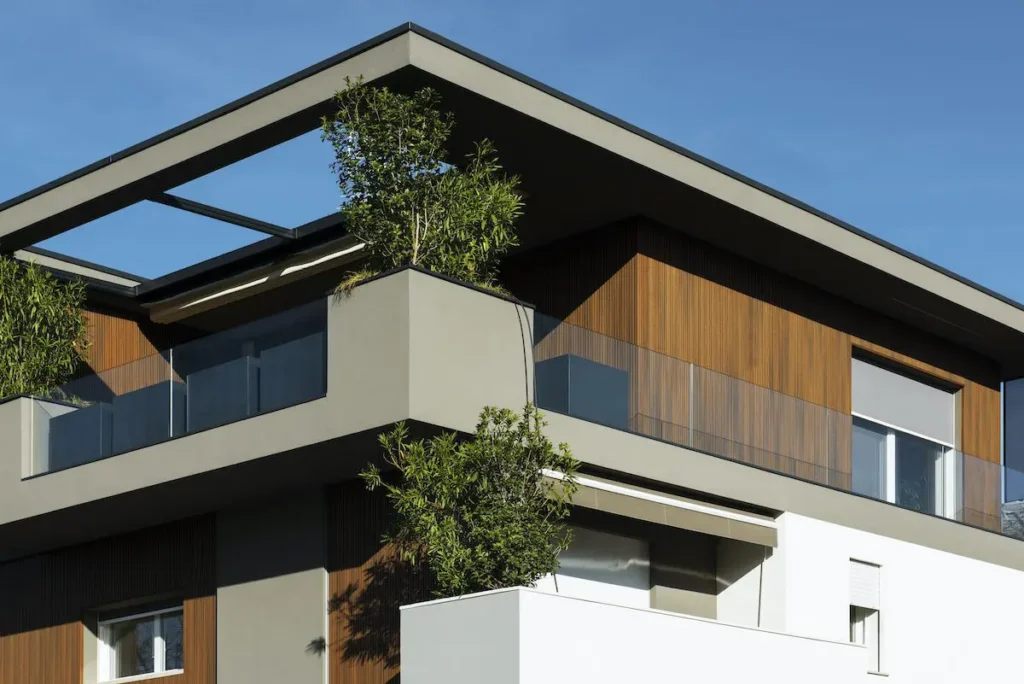
Scenario 1: The High-UV High-Desert Environment
A commercial building in Arizona faces 300+ days of intense solar radiation.
-
Constraint: Standard finishes will fade and chalk within five years.
-
Decision Point: Moving away from painted surfaces toward integral color materials like terracotta or GFRC (Glass Fiber Reinforced Concrete).
-
Second-Order Effect: The high thermal expansion of the terracotta requires larger expansion joints, which must be carefully designed to avoid “ghosting” (dirt patterns forming on the joints).
Scenario 2: The Urban Infill Fire-Zone
A multi-family residential unit built on a narrow lot in a dense city.
-
Constraint: Building codes require a 2-hour fire rating for the exterior wall.
-
Failure Mode: Using high-pressure laminate (HPL) panels without an expensive fire-rated substrate.
-
Solution: Specifying a non-combustible mineral wool insulation paired with a metal or stone facade.
Planning, Cost, and Resource Dynamics
The financial planning for building skins is often skewed by “first-cost” bias. A comprehensive budget must account for the cladding itself, the sub-framing (the “hat channels” or “Z-girts”), the labor for complex corner details, and the equipment (scaffolding or cranes).
Cost Variability (Installed Price per Square Foot)
| Material | Low-End Est. | High-End Est. | Primary Variance Factor |
| Fiber Cement | $12 | $22 | Texture and trim complexity |
| Aluminum Panels | $25 | $55 | Gauge thickness and finish |
| Terracotta | $60 | $120 | Custom shapes and glazing |
| Natural Stone | $70 | $150+ | Stone rarity and thickness |
| Stucco/EIFS | $10 | $18 | Layers of drainage/insulation |
Risk Landscape and Failure Modes
The most significant risk in cladding is not the material failing, but the “transition” failing. A transition is anywhere the cladding meets something else: a window, a door, a roofline, or a different material.
-
Capillary Break Failure: If the cladding is installed too close to the ground or a roof surface, it can “wick” water upward into the wall cavity.
-
Incompatible Sealants: Some silicone sealants can chemically react with the coatings on metal panels, leading to “adhesion failure” where the sealant simply peels away after one season.
-
Thermal Shock: In materials like large-format porcelain or dark-colored metal, rapid temperature changes (e.g., a cold rain hitting a sun-heated wall) can cause cracking or “oil canning” (visible waving in the metal).
Governance, Maintenance, and Long-Term Adaptation
A building’s exterior requires a governance plan similar to a mechanical system. Without a regular inspection cycle, minor issues like a clogged weep hole can escalate into six-figure mold remediation projects.
Layered Maintenance Checklist
-
Visual Audit (Quarterly): Check for staining or “efflorescence” (white salty deposits on brick) which indicates water is trapped inside the wall.
-
Sealant Inspection (Annual): Poke and prod the caulking around windows. If it has lost its elasticity, it is no longer a gasket; it is a leak point.
-
Mechanical Wash (Bi-Annual): Especially for metal and fiber cement, removing salt and pollutants prevents the finish from breaking down prematurely.
-
Documentation: Keep a log of every repair. If a specific corner keeps leaking, it points to a structural settling issue rather than a cladding failure.
Measurement, Tracking, and Evaluation
Post-installation evaluation is the only way to confirm that the best exterior cladding options were actually chosen.
-
Leading Indicators: Blower-door testing after the weather barrier is installed but before the cladding goes on. This measures the “airtightness” of the shell.
-
Qualitative Signals: “Oil canning” in metal panels. While not a structural failure, it is a qualitative failure of the aesthetic intent, often caused by over-tightening fasteners.
-
Quantitative Metrics: Monitoring the interior humidity levels during extreme weather. A spike in humidity during a rainstorm is a lagging indicator of a breach in the exterior skin.
Common Misconceptions
-
“Stone is maintenance-free”: False. While the stone itself is durable, the mortar joints or the stainless steel anchors require periodic inspection to prevent falling hazards.
-
“Vinyl is the only cheap option”: Engineered wood and some modern stuccos offer similar price points with significantly better durability and environmental profiles.
-
“Dark colors are just an aesthetic choice”: Dark cladding can increase the “cooling load” of a building by 20% or more in sunny climates, drastically affecting the HVAC budget.
-
“Warranties guarantee performance”: Most cladding warranties are pro-rated and only cover the material itself, not the labor to replace it or the damage caused to the interior when it leaks.
Conclusion
The selection of a building’s exterior is an act of intellectual honesty. It requires admitting that the environment is hostile and that every material has a shelf life. The best exterior cladding options are those that acknowledge these realities through redundant drainage planes, flexible attachment systems, and a commitment to long-term maintenance. In a world where “disposable architecture” is becoming common, choosing a high-performance, durable skin is a statement of permanence and a hedge against the rising costs of energy and repair. The true value of an exterior is not found in its appearance on opening day, but in its ability to remain boring and functional thirty years later.