Facade Thermal Performance Analysis: The Definitive Pillar Guide
The facade of a modern building is a site of constant energetic negotiation. It stands as the primary regulator of heat flux, tasked with the paradoxical role of being a transparent window to the world while acting as a robust thermal barrier. In an era where building operations account for a massive share of global carbon emissions, the efficiency of this “skin” has moved from a matter of occupant comfort to a critical pillar of global environmental policy. Facade Thermal Performance Analysis. A building’s thermal success is no longer judged solely by its furnace or chiller, but by the physical integrity of the envelope that encases them.
As architectural geometries become more daring and glazing ratios increase, the physics of the facade becomes exponentially more difficult to manage. We have moved far beyond the days of simple R-value calculations for solid walls. Today’s envelopes are heterogeneous assemblies of glass, aluminum, thermal breaks, and complex gaskets—each with vastly different conductive properties. A single poorly designed bracket or a misinterpreted sealant joint can act as a thermal “short circuit,” undermining millions of dollars in high-performance glazing and high-efficiency mechanical systems.
Navigating this complexity requires a move toward forensic-level building science. It involves understanding not just how much heat moves through a material, but how air leakage carries moisture and how surface temperatures dictate the risk of condensation and mold. To achieve a truly resilient structure, designers and developers must adopt a lifecycle perspective, recognizing that the thermal decisions made during the schematic phase will dictate the building’s operational costs and structural health for the next half-century.
Facade thermal performance analysis
To accurately define Facade thermal performance analysis, one must view it as a multi-dimensional simulation of how a building skin interacts with climate over time. It is not a static calculation. A common misunderstanding in the industry is that thermal performance is synonymous with “insulation thickness.” In reality, the most significant heat losses in modern commercial buildings often occur not through the insulation itself, but through “thermal bridges”—the structural elements that bypass the insulation—and through uncontrolled air infiltration.
Oversimplification in this field often leads to the “Component Trap.” A developer might see a glass unit with an impressive center-of-glass U-value and assume the entire facade will perform at that level. However, Facade thermal performance analysis accounts for the “assembly U-value,” which includes the edge-of-glass effects and the conductivity of the aluminum frames. Aluminum is highly conductive; without sophisticated thermal breaks (usually polyamide or polyurethane strips), a window frame can lose heat hundreds of times faster than the glass it holds.
The risk of ignoring this systemic view is profound. If the analysis is performed as a “check-the-box” exercise for code compliance rather than a genuine design tool, the result is often a building that suffers from “interstitial condensation.” This occurs when warm, moist interior air hits a cold surface inside the wall assembly, leading to hidden rot and mold. Professional analysis seeks to prevent these forensic disasters by modeling the temperature gradients across every layer of the facade, ensuring the “dew point” stays safely outside the sensitive structural cavities.
Historical Context: From Mass to Managed Flux
The history of facade thermal behavior is a transition from “storage” to “resistance.” For centuries, buildings utilized “mass walls”—thick layers of stone, brick, or adobe. These walls didn’t resist heat so much as they delayed it. Their thermal mass absorbed solar heat during the day and radiated it inward at night. This “thermal lag” was effective in arid climates but struggled in regions with extreme, sustained seasonal temperatures.
The 20th-century introduction of the lightweight curtain wall broke this relationship. By moving to thin skins of glass and metal, buildings lost their “buffer.” They became highly sensitive to the external environment, leading to the massive expansion of HVAC systems to compensate for the “greenhouse effect” of single-pane glass. The energy crises of the 1970s forced the first generation of thermal performance awareness, leading to the development of double-glazing and basic insulation standards.
Today, we are in the third era: the “High-Performance Integrated Envelope.” We are seeing the rise of vacuum-insulated panels (VIPs), triple-glazing with low-emissivity (Low-E) coatings, and “thermal breaks” that are engineered with the precision of aerospace components. The facade is no longer a passive wall; it is a tuned filter, capable of admitting light while reflecting infrared radiation and maintaining a continuous thermal barrier across complex structural junctions.
Conceptual Frameworks and Thermodynamic Mental Models
Experts in building science utilize specific mental models to categorize heat movement and identify vulnerabilities.
1. The Continuity Principle
Just as a chain is only as strong as its weakest link, a thermal envelope is only as effective as its most conductive point. The “Continuity Principle” dictates that the thermal control layer must be traceable and unbroken from the roof to the foundation. If a structural steel beam penetrates the insulation without a thermal break, it creates a “hole” in the bucket, allowing energy to pour out regardless of the R-value of the surrounding wall.
2. The Three-Mode Flux Model
This model forces the analyst to look at Conduction (heat moving through solids), Convection (heat moving through air), and Radiation (heat moving via light/infrared). In high-rise facades, radiation often dominates the solar heat gain, while conduction dominates the frame losses, and convection (air leaks) dominates the moisture risk. A balanced analysis must address all three modes simultaneously.
3. The Dew Point Gradient
This mental model visualizes the temperature drop across the wall assembly. By plotting the temperature from the warm interior to the cold exterior, the analyst can identify exactly where the “dew point” (the temperature at which water vapor turns to liquid) occurs. The goal of high-performance design is to ensure the dew point always occurs within the drainage plane or on the exterior of the air barrier.
Key Categories of Thermal Assemblies
The selection of a facade system involves a direct trade-off between transparency, weight, and thermal resistance.
| System Type | Thermal Logic | Best Application | Primary Trade-off |
| Unitized Curtain Wall | Large glass units; internal thermal breaks. | High-rise; fast-track. | High edge-of-glass heat loss. |
| Rainscreen (Drained) | Cladding over an air gap & insulation. | Low-to-mid rise; institutional. | Complex detailing at penetrations. |
| Double-Skin Facade | Air buffer between two glass skins. | Sustainable “trophy” buildings. | High cost; consumes floor space. |
| EIFS (Insulated Stucco) | Continuous exterior insulation. | Budget-conscious residential. | Low durability/impact resistance. |
| Vacuum Insulated Glazing | Near-zero gas conduction in glass. | High-performance retrofit. | Fragile; high manufacturing cost. |
Detailed Real-World Scenarios Facade Thermal Performance Analysis
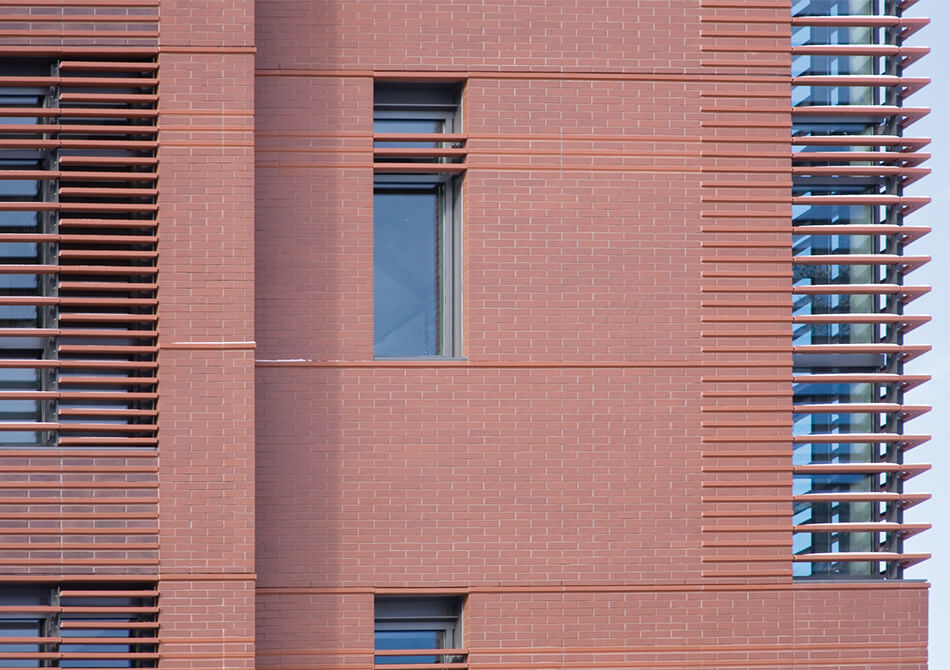
Scenario 1: The “Cold-Bridge” Balcony
In a luxury residential tower, the concrete floor slabs extend outward to form balconies.
-
The Constraint: Structural stability requires continuous concrete.
-
The Decision Point: Without a thermal break, the balcony slab acts as a giant “cooling fin,” chilling the interior floor and causing condensation under the hardwood.
-
The Solution: Installing structural thermal break modules at the slab edge to decouple the interior and exterior concrete.
Scenario 2: The High-Altitude Office Tower
A building in a cold, sunny climate (like Denver or Calgary) experiences massive solar gain during the day and extreme cold at night.
-
The Constraint: Managing “thermal shock” and extreme expansion/contraction.
-
The Analysis: Facade thermal performance analysis reveals that standard double-glazing will lead to overheating in winter.
-
The Solution: Spectrally selective Low-E coatings that allow visible light but block the infrared heat, paired with high-performance polyamide thermal breaks in the frames.
Planning, Cost, and Resource Dynamics
The economics of thermal performance are governed by “Operational vs. Capital” expenditure. A 10% increase in facade cost can often be recovered in 5-7 years through reduced mechanical plant size and lower monthly utility bills.
Investment Variance Table
| Phase | Resource Required | Cost Impact | Potential Saving |
| Schematic Design | Thermal modeling consultant | Low | Reduces HVAC chiller size requirement. |
| Materials | Triple glazing / Polyamide breaks | High | 20-40% reduction in heating/cooling. |
| Testing | Blower door / Infrared audit | Moderate | Prevents multi-million dollar mold remediation. |
| Maintenance | Sealant & Gasket check | Low | Maintains “as-built” performance. |
Technical Tools, Strategies, and Support Systems
Modern analysis relies on high-fidelity simulation software that can model heat flow in two and three dimensions.
-
THERM / WINDOW (LBNL): The industry standard for modeling 2D heat transfer through window frames and glass edges.
-
WUFI (Hygrothermal): Simulates the movement of moisture and heat through walls over a multi-year period using specific local weather data.
-
3D Heat Flow Analysis (Heat3): Essential for modeling complex corners or “punctures” where 2D models fail to capture the full thermal bridge.
-
Blower Door Testing: A physical test to measure the airtightness of the assembly; air leaks are often the “hidden” cause of thermal failure.
-
Infrared Thermography: A post-construction diagnostic tool to verify that the insulation was installed correctly and that no unexpected thermal bridges exist.
-
Solar Heat Gain Coefficient (SHGC) Modeling: Calculating the “G-value” to ensure the building doesn’t overheat in the summer.
Risk Landscape and Thermal Failure Modes
Thermal failure is rarely “sudden.” It is a slow, compounding decay of the building’s health.
-
Failing Sealant/Gaskets: When gaskets shrink or fail, “convective loops” form. Cold air enters the frame, bypasses the thermal break, and chills the interior surface.
-
Inaccessible Condensation: If the dew point is inside a closed wall cavity, mold can grow for years before it is detected by scent or health symptoms in occupants.
-
Glass Thermal Stress: If one part of a glass pane is shaded and another is in hot sun, the temperature difference can cause the glass to spontaneously crack.
-
“Short-Circuiting” Brackets: Using metal brackets to hold a rainscreen that go all the way through the insulation to the steel studs, effectively negating 30-50% of the insulation’s R-value.
Governance and Long-Term Adaptation
A high-performance facade is a “living” asset that requires governance to maintain its thermal rating over 50 years.
-
Monitoring Triggers: If interior humidity levels spike, it is often a sign of an envelope breach rather than a mechanical failure.
-
Adjustment Cycles: Every 10-15 years, a “thermal audit” using infrared cameras should be conducted to check for settling insulation or failed seals.
-
Retrofit Triggers: As energy codes evolve (e.g., Local Law 97 in NYC), buildings may be legally required to “re-skin” or add secondary glazing to meet new carbon limits.
Measurement and Evaluation Metrics
How do you measure the success of Facade thermal performance analysis?
-
Leading Indicators: The “Assembly U-value” compared to the “Center-of-Glass U-value”; the number of thermal bridges identified and eliminated in the design phase.
-
Lagging Indicators: Total energy use intensity (EUI) of the building; actual versus predicted utility costs; absence of condensation during the first “design-day” winter storm.
-
Documentation: A “Thermal Map” of the building, identifying every critical junction and the specific thermal break specified, to guide future repairs.
Common Misconceptions and Oversimplifications
-
“R-value is all that matters.” In facades, R-value (resistance) is only half the story. Airtightness is often more important for both comfort and moisture control.
-
“Double-glazing is ‘standard’ enough.” In many modern climates, double-glazing is no longer sufficient to meet high-performance energy codes or to prevent condensation at the edges.
-
“Thermal breaks are just plastic strips.” High-performance breaks are engineered polymers designed to handle the structural weight of the glass while being non-conductive.
-
“A thicker wall is a warmer wall.” A thin wall with a continuous thermal break will outperform a thick wall with structural steel “stabbing” through it every two feet.
Conclusion
The integrity of a building’s thermal performance is determined at the “micro-scale”—the millimeters where glass meets metal and metal meets concrete. As we move toward a carbon-neutral built environment, the rigor applied to Facade thermal performance analysis will distinguish between buildings that are durable assets and those that are operational liabilities. The goal is not just to insulate, but to create a seamless, resilient barrier that respects the laws of thermodynamics while fostering human comfort. In the end, a building’s beauty is only as sustainable as the thermal logic that protects its interior.