Top Architectural Siding Plans: A Definitive Guide to Building Envel
The envelope of a building is rarely a singular choice of material; it is a complex negotiation between environmental physics, structural integrity, and aesthetic intent. When navigating the selection of top architectural siding plans, one must move beyond the superficiality of color palettes and focus on the systemic performance of the building skin. This inquiry requires an understanding of how moisture moves through assemblies, how thermal bridges compromise efficiency, and how various materials age under specific UV and precipitation loads.
Modern architectural practice has shifted away from seeing siding as a mere “cladding” and toward viewing it as a critical component of a high-performance rainscreen system. This evolution reflects a growing awareness of building longevity. A plan that prioritizes initial cost without accounting for expansion and contraction coefficients often leads to premature failure, regardless of the material’s inherent quality. Consequently, the distinction between a standard installation and a superior architectural plan lies in the detailing—the flashing, the ventilation gaps, and the integrated drainage planes.
This exploration seeks to deconstruct the technical and conceptual layers of exterior cladding. By examining the intersections of material science, regional climate pressures, and long-term maintenance cycles, we can establish a rigorous framework for decision-making. The goal is to provide a reference that balances the immediate visual impact of a structure with the invisible, yet vital, engineering that ensures its permanence.
Understanding “Top Architectural Siding Plans”
The term top architectural siding plans is often misinterpreted as a list of popular materials or trending aesthetic styles. In a professional editorial context, however, these plans refer to the comprehensive technical blueprints that dictate how a building’s exterior shell interacts with its internal systems and the external environment. A “plan” in this sense is not just a drawing; it is a strategic approach to moisture management, thermal resistance, and structural movement.
A primary misunderstanding in the residential and commercial sectors is the belief that the material itself—be it fiber cement, natural cedar, or metal panels—defines the quality of the project. In reality, the most sophisticated plans are those that account for the interstitial space behind the siding. A high-quality plan might utilize a modest material in a highly engineered rainscreen configuration, outperforming an expensive material installed with poor drainage logic.
Oversimplification risks are rampant in this field. Many stakeholders focus on “curb appeal” while ignoring the second-order effects of their choices, such as how specific siding profiles might trap debris or how dark pigments increase thermal expansion, putting stress on fasteners. To truly engage with top architectural siding plans, one must look at the assembly as a whole: the substrate, the water-resistive barrier (WRB), the furring strips or drainage mats, and finally, the visible cladding.
Deep Contextual Background: The Evolution of the Building Skin
Historically, the building skin was synonymous with the structure itself. Masonry and heavy timber served as both the load-bearing element and the weather barrier. This “mass wall” approach relied on thickness to manage moisture; stone or brick would absorb water during a storm and slowly release it as the weather cleared. The transition to frame construction in the 19th century necessitated a shift toward “barrier” systems—thin layers of wood or early composite materials intended to shed water entirely.
The mid-20th century saw the rise of synthetic materials, including vinyl and aluminum, which promised a “maintenance-free” existence. However, these systems often failed because they did not account for vapor permeability. Moisture trapped behind non-breathable siding led to catastrophic rot in the structural framing. This period taught the industry a vital lesson: you cannot perfectly seal a building; you must instead give it a way to dry.
Today, the state of the art involves “vented” or “pressure-equalized” rainscreens. These systems acknowledge that water will eventually find its way behind the cladding. By creating a deliberate air gap, top architectural siding plans allow for pressure equalization, which prevents wind-driven rain from being sucked into the wall cavity, and provides a path for drainage and evaporation. This historical trajectory from mass walls to managed drainage represents the pinnacle of modern building science.
Conceptual Frameworks and Mental Models
To evaluate siding options effectively, professionals often use specific mental models that prioritize performance over appearance.
1. The Rainscreen Principle
This model views the siding not as a waterproof seal, but as a “sacrificial” outer layer. Its primary job is to deflect the majority of water and UV radiation, while the “real” weather barrier sits safely behind an air gap. This framework shifts the focus from “how do we stop water?” to “how do we manage the water that gets in?”
2. The Four Control Layers
Architects prioritize four layers in every wall assembly: water, air, vapor, and thermal. A superior siding plan must integrate with these layers without compromising them. For example, a heavy stone cladding plan must ensure that the fasteners do not create significant thermal bridges that degrade the building’s insulation.
3. Service Life Prediction (SLP)
This framework evaluates materials based on their degradation curves in specific microclimates. A material that lasts 50 years in an arid environment might only last 15 in a coastal, high-humidity zone. Planning involves matching the material’s lifecycle to the owner’s investment horizon.
Material Categories and Performance Variations
When selecting from top architectural siding plans, the material choice is the most visible decision. Each category carries distinct trade-offs regarding weight, fire resistance, and environmental impact.
| Material Category | Primary Benefit | Significant Limitation | Best Use Case |
| Fiber Cement | Fire/Rot resistance | Heavy; requires specialized cutting | Suburban residential; multi-family |
| Natural Wood (Cedar/Ipe) | Aesthetic warmth | High maintenance; prone to movement | Custom luxury residential |
| Thermally Modified Wood | Dimensional stability | Brittle; higher cost than standard wood | Modernist designs in harsh climates |
| Engineered Wood | Cost-effective; uniform | Subject to moisture if edges aren’t sealed | Value-driven high-quality builds |
| Metal Panels (Zinc/Steel) | Longevity; recyclability | High initial cost; oil-canning risk | Commercial/Industrial-chic |
| High-Pressure Laminate | Extreme durability | Specialized installation required | High-traffic commercial envelopes |
Realistic Decision Logic
Choosing between these materials is rarely about finding the “best” one, but rather the most “appropriate” one for the site’s constraints. For instance, a coastal project should likely avoid certain steel alloys due to salt-spray corrosion, leaning instead toward aluminum or high-grade fiber cement. Conversely, a project in a high-fire-risk zone (WUI) must prioritize non-combustible materials regardless of the aesthetic desire for natural wood.
Detailed Real-World Scenarios Top Architectural Siding Plans
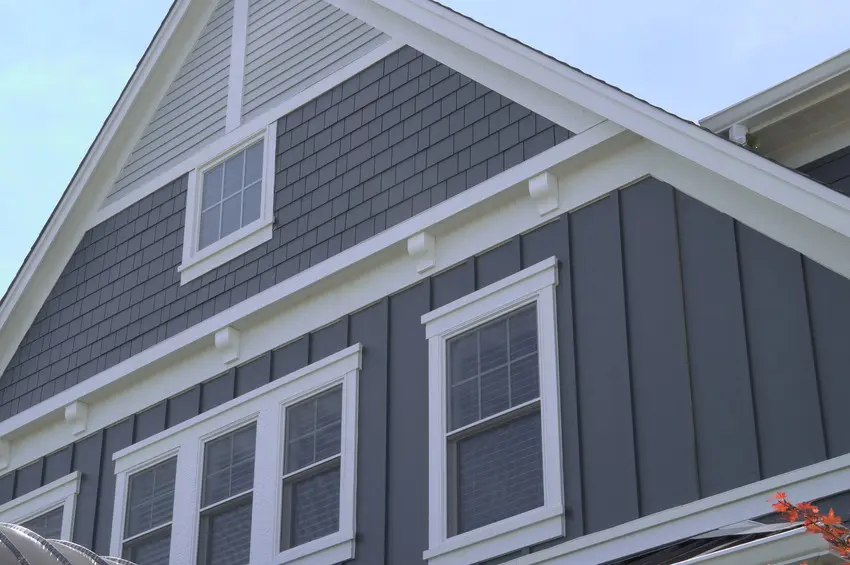
Scenario A: High-Exposure Coastal Infill
In this scenario, wind-driven rain and salt air are the primary threats. A plan utilizing a ventilated rainscreen with stainless steel fasteners and a high-performance WRB is essential. The failure mode here is often “corrosion creep,” where salt settles behind the siding and eats away at standard galvanized nails, eventually causing panels to loosen during high winds.
Scenario B: High-Diurnal Temperature Swing Regions
In high-desert climates, materials undergo massive expansion and contraction daily. Metal and vinyl are particularly susceptible. A plan for this environment must include “floating” fastener systems and oversized expansion joints to prevent buckling—a phenomenon known as oil-canning in metal panels.
Scenario C: Urban Retrofit with Limited Eave Overhang
Buildings with small or no eaves have much higher “wash” on their siding. Without the protection of a roof overhang, the siding is constantly saturated. Here, the plan must prioritize a larger drainage gap (at least 3/4 inch) to ensure rapid drying between rain events.
Economic Dynamics: Costs, Resources, and Longevity
The economics of top architectural siding plans are often obscured by a focus on “price per square foot.” A more accurate metric is the Total Cost of Ownership (TCO), which includes installation labor, finishing (painting/staining), and the discounted cost of future maintenance.
Indirect and Opportunity Costs
Using a material that requires painting every five years (like certain wood species) creates a recurring financial drain. Alternatively, a high-cost material like zinc might have a 100-year lifespan with zero maintenance, representing a massive long-term saving despite a staggering initial price tag.
| Cost Component | Low-End (Vinyl/Basic Wood) | Mid-Range (Fiber Cement) | High-End (Metal/HPL/Stone) |
| Material ($/sq ft) | $2 – $5 | $5 – $12 | $15 – $40+ |
| Labor Complexity | Low | Moderate | High/Specialized |
| Maintenance Cycle | 10-15 Years (Replace) | 15 Years (Paint) | 30-50 Years (Inspect) |
Tools, Strategies, and Support Systems
Executing a sophisticated siding plan requires more than a hammer and nails. It requires a suite of technical tools and strategic approaches.
-
BIM (Building Information Modeling): Used to calculate exact material counts and visualize complex flashing details before a single board is cut.
-
Thermal Imaging: Post-installation tool to ensure the siding system hasn’t created thermal bridges or trapped moisture.
-
Stainless Steel Fasteners: A non-negotiable for longevity, especially in tannic woods like cedar or in coastal zones.
-
Back-Priming: The practice of sealing the rear and edges of wood or fiber cement to prevent moisture absorption from the back.
-
Z-Girts and Hat Channels: Metal components used to create the air gap in commercial-grade rainscreens.
-
Integrated Flashing Systems: Moving away from field-bent aluminum to pre-engineered corner and window transitions.
Risk Landscape and Failure Modes
The most common failure in top architectural siding plans is not the material itself, but the interface transitions. Where the siding meets a window, a door, or a roofline is where 90% of water intrusion occurs.
Compounding Risks
-
Reverse Lapping: When a higher layer of flashing is tucked behind a lower layer, effectively funneling water into the wall.
-
Inadequate Drainage: Using a housewrap that is too smooth, allowing water to be held against the siding by capillary action.
-
Over-Fastening: Pinning a material so tightly that it cracks when it tries to expand.
Governance, Maintenance, and Long-Term Adaptation
A building is a living entity that requires a governance structure for its exterior. This includes scheduled “walk-arounds” to identify early signs of wear, such as caulking failure or localized fading.
Adjustment Triggers
Architectural plans should include a maintenance manual for the owner. For example, if a building uses a “natural weathering” wood, the trigger for intervention might be uneven graying caused by inconsistent UV exposure. In a metal system, the trigger might be the accumulation of debris in the weep holes at the base of the wall.
Measurement, Tracking, and Evaluation
How do we know if a siding plan is succeeding? We look at leading and lagging indicators.
-
Leading Indicators: Moisture meter readings of the substrate during the first three years; visual check of fastener tightness.
-
Lagging Indicators: Energy bills (indicating thermal performance); absence of interior mold; paint adhesion levels after a decade.
Documentation is the backbone of this evaluation. Keeping “as-built” drawings that show exactly where every flashing piece is located is invaluable for future repairs or modifications.
Common Misconceptions and Oversimplifications
-
Myth: Fiber cement is “waterproof.”
-
Correction: It is water-resistant, but it is porous. If left in standing water or installed without a gap, it will delaminate.
-
Myth: Metal siding makes the house hotter.
-
Correction: With a proper air gap (rainscreen), metal siding can actually reduce heat gain by shading the wall and allowing heat to escape via the chimney effect in the gap.
-
Myth: “Maintenance-free” exists.
-
Correction: Every material requires inspection. Even stone can have mortar failure or biological growth (lichen) that needs management.
Ethical and Practical Considerations
In the modern era, the carbon footprint of top architectural siding plans is a significant consideration. The “embodied carbon” of aluminum or vinyl is high, while sustainably harvested wood acts as a carbon sink. Designers must weigh the long-term durability (which reduces waste) against the environmental cost of production. Furthermore, the “right to repair” applies to architecture; choosing a proprietary cladding system that may go out of business in ten years creates a risk that a small patch of damage might eventually require a full building reclad.
Synthesis: The Future of the Envelope
The pursuit of top architectural siding plans is ultimately a pursuit of balance. It is a rejection of the “quick fix” in favor of a layered, resilient approach. As climates become more volatile, with higher wind loads and more intense heat waves, the exterior skin of our buildings must work harder than ever.
Success in this domain is measured not by the brilliance of the facade on day one, but by its performance on day 10,000. By prioritizing the physics of the wall assembly over the trends of the moment, and by treating the building skin as a sophisticated engine for moisture and thermal management, architects and builders can create structures that are both beautiful and enduring. The complexity of these systems is not a burden, but an opportunity to build with greater honesty and technical mastery.