Facade Diagnostic and Forensic Engineering: The Definitive Guide
The architectural skin of a modern building is its most vulnerable interface, a high-stakes assembly where material science, structural engineering, and environmental physics converge. When a facade fails—whether through chronic water infiltration, catastrophic material detachment, or systemic thermal inefficiency—the consequences extend far beyond aesthetics. Facade Diagnostic and Forensic Engineering. They encompass significant financial liability, threats to occupant safety, and the potential for long-term structural degradation. Unlike interior systems that can be easily accessed and repaired, the exterior envelope is often a “closed box,” where the root causes of distress are hidden beneath layers of cladding, insulation, and moisture barriers.
Resolving these complexities requires more than a simple visual inspection; it demands a systematic, multidisciplinary approach to investigation. The field has evolved from reactive “leak chasing” into a rigorous scientific pursuit that combines high-tech non-destructive testing with a deep understanding of legacy construction methods and modern material compatibility. The goal is to move from treating symptoms to identifying the “mechanism of failure”—the precise sequence of events, from design oversight to environmental stressors, that led to the current state of distress.
In the contemporary landscape of high-density urban developments and aging architectural icons, the ability to accurately diagnose facade behavior is a prerequisite for any meaningful restoration or asset management strategy. A failure to appreciate the nuances of building physics during an investigation often leads to remedial efforts that are not only expensive but, in many cases, counterproductive. True mastery in this discipline lies in the ability to synthesize disparate data points—thermal images, moisture probes, and structural calculations—into a coherent narrative that informs a durable, long-term solution.
Facade diagnostic and forensic engineering
To define Facade diagnostic and forensic engineering is to acknowledge it as a specialized branch of engineering that treats the building envelope as a forensic site. While traditional engineering focuses on the “creation” of systems, the forensic variant focuses on the “deconstruction” of failure. A common misunderstanding in the industry is that these services are merely about finding leaks. In reality, a forensic investigation seeks to uncover why a specific assembly failed to perform as intended, considering the interaction between the design intent, the reality of the construction site, and the relentless pressure of the local micro-climate.
Oversimplification in this field is a primary driver of litigation. Stakeholders often assume that if a window leaks, the window is defective. However, a forensic engineer might discover that the leak is actually caused by air pressure differentials driving water through a poorly detailed sill flashing three floors above. The risk of treating the symptom (replacing the window) without addressing the diagnosis (fixing the flashing and air barrier) leads to a cycle of failed repairs and escalating costs. Diagnostic engineering provides the intellectual honesty required to tell a client that the obvious problem is rarely the actual problem.
The multi-perspective nature of the work is critical. An investigation must account for the structural stability of the panels, the chemical compatibility of the sealants, the thermal integrity of the frames, and the hygrothermal behavior of the wall cavity. This level of depth is necessary because facade systems are rarely monolithic; they are heterogeneous assemblies where different materials—metal, glass, stone, and polymers—expand and contract at different rates. Understanding these “conflicting movements” is the cornerstone of a successful forensic diagnosis.
The Contextual Evolution of Forensic Building Science
The history of facade failure tracking has moved from the era of “mass” masonry to the era of “barrier” and “rainscreen” complexity. In the mid-20th century, buildings relied on thickness and thermal mass. When these walls leaked, the water was usually absorbed and eventually evaporated. Forensic work back then was largely focused on structural cracking or mortar degradation.
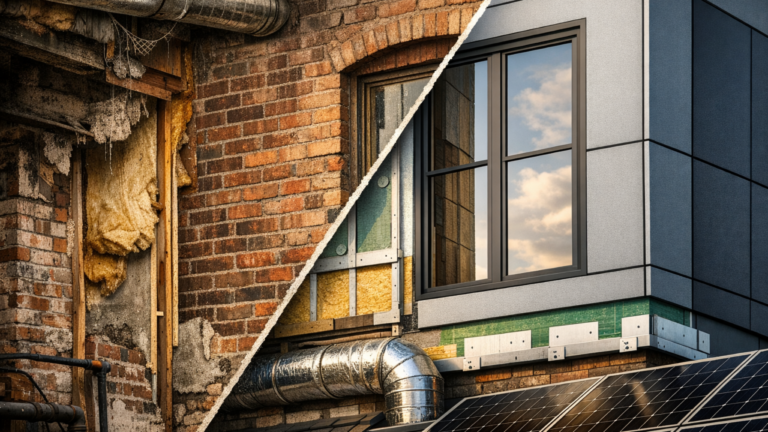
The shift toward lightweight curtain walls and thin veneers in the 1970s and 80s changed the risk profile entirely. These systems had almost zero “hygric buffer”—meaning they had no capacity to store moisture safely. If water got behind a thin stone veneer or an EIFS (Exterior Insulation and Finish System) panel, it stayed there, rotting the substrate and corroding the anchors. This era birthed the modern forensic industry as we know it, fueled by the “Leaky Condo” crises and the failure of early-generation sealants.
Today, we are in the era of “Integrated Complexity.” Modern facades are packed with sensors, high-performance coatings, and complex thermal breaks. The forensic engineer today must be part data scientist and part chemist, as failures are increasingly related to “invisible” factors like interstitial condensation (moisture forming inside a wall) or the premature degradation of high-tech coatings due to unforeseen atmospheric pollutants.
Conceptual Frameworks and Investigative Mental Models
Experienced forensic engineers utilize specific mental models to guide their investigations, preventing them from falling into the trap of “confirmation bias.”
1. The “Path of Least Resistance” Framework
Water and air do not follow the path the architect intended; they follow the path of least physical resistance. This model forces the investigator to look at the “hidden” paths—the gaps in the sealant, the un-taped joints in the air barrier, and the capillary action at the joints.
2. The Serviceability vs. Integrity Spectrum
This framework distinguishes between a “nuisance” failure (a small leak) and a “structural” failure (a loose panel). However, in forensic engineering, the two are often linked. A serviceability failure, if left unaddressed, eventually becomes a structural failure through the corrosion of hidden steel anchors.
3. The “Hygrothermal” Loop
This model considers the movement of heat and moisture together. In many cold-climate failures, the water isn’t coming from the outside (rain); it is coming from the inside (humidity) and condensing on cold surfaces within the wall. This framework prevents the investigator from wrongly blaming the exterior waterproofing for an interior ventilation problem.
Key Categories of Facade Distress
Forensic investigations generally categorize distress into specific mechanical or chemical groupings.
| Category | Primary Symptom | Root Cause Logic | Trade-off / Risk |
| Water Infiltration | Mold; damp drywall; efflorescence. | Breach in the “Water Control Layer” or flashing. | Hardest to trace; often distant from the symptom. |
| Air Leakage | Drafts; whistling; high energy bills. | Discontinuity in the air barrier/gaskets. | Causes condensation inside the wall. |
| Material Degradation | Spalling stone; “chalking” paint; brittle sealants. | UV exposure; chemical incompatibility; oxidation. | Often requires full material replacement. |
| Structural Distress | Bowing panels; cracked glass; loose anchors. | Wind load overstress; thermal expansion; corrosion. | Immediate safety hazard; highest liability. |
| Thermal Bridging | “Ghosting” on walls; ice dams. | Short-circuit in insulation by metal elements. | Leads to rot and mold in hidden cavities. |
Detailed Real-World Scenarios Facade Diagnostic and Forensic Engineering
Scenario 1: The “Ghost” Leak in a High-Rise
A luxury high-rise experiences water dripping from a 20th-floor ceiling during heavy rain, but only when the wind blows from the North.
-
The Diagnosis: Using Facade diagnostic and forensic engineering, the team discovers that the wind pressure is “pumping” air into the wall cavity. This air carries water through an unsealed penetration in the mechanical room two floors above.
-
The Failure Mode: The water travels horizontally along a steel beam before dropping.
-
Second-Order Effect: Simple caulking of the 20th-floor window would have done nothing to stop the 22nd-floor leak.
Scenario 2: The Spalling Stone Veneer
A historic building with a new stone veneer starts shedding small flakes of stone.
-
The Diagnosis: The forensic engineer finds that the mortar used was too “strong” (high cement content).
-
The Failure Mode: When the stone expanded in the sun, the mortar didn’t give way. The stone, being the “weaker” element, crushed itself at the edges.
-
The Decision Point: Replacing the stone is useless unless the mortar is swapped for a softer, lime-based alternative.
Planning, Cost, and Resource Dynamics
The economics of forensic work are dictated by the “Law of Information.” The more you spend on the investigation, the less you spend on the repair.
Forensic Investigation Resource Table
| Phase | Scope of Work | Cost Impact (Est.) | Value Add |
| Phase I: Desktop Review | Reviewing original blueprints and specs. | $5,000 – $15,000 | Identifies “design-intent” flaws. |
| Phase II: Site Probe | Borescope cameras; infrared scans. | $10,000 – $30,000 | Finds hidden moisture/rot without demolition. |
| Phase III: Destructive Testing | Removing sections of the facade to see anchors. | $20,000 – $60,000 | Provides 100% certainty of the failure mode. |
| Phase IV: Laboratory Analysis | Testing sealant adhesion or metal corrosion. | $5,000 – $20,000 | Confirms material compatibility. |
Tools, Strategies, and Technical Support Systems
Modern forensic engineering relies on a “toolkit” that bridges the gap between the visible and the invisible.
-
Infrared Thermography: Identifying “cold spots” where insulation is missing or “wet spots” where water is trapped behind the skin.
-
Nuclear Moisture Gauges: Detecting moisture deep within roofing or wall assemblies without cutting into them.
-
Borescope Inspection: Inserting tiny cameras into weep holes to inspect the condition of internal flashings and anchors.
-
Spray Bar/Rilew Tube Testing: Creating a “controlled rainstorm” on a specific section of the wall to observe exactly where water enters.
-
Electronic Leak Detection (ELD): Using an electric field to find pinhole leaks in membranes that are impossible to see with the naked eye.
-
Ultrasonic Thickness Testing: Measuring the thickness of metal anchors to determine how much they have thinned due to rust.
Risk Landscape and Compounding Failure Modes
In the world of facades, risks are rarely linear; they are compounding. A “Taxonomy of Failure” often looks like this:
-
The Trigger: A small sealant crack.
-
The Accelerator: High wind pressure driving water through that crack.
-
The Compounder: That water staying in a cavity with no drainage, leading to the corrosion of a structural bolt.
-
The Result: A panel becomes loose, creating a life-safety risk for pedestrians.
Forensic engineers look for “single points of failure.” If a system relies entirely on one bead of caulk for its survival, it is a high-risk system. Modern engineering promotes “redundancy”—meaning the building should be able to lose its primary seal and still keep water out through a secondary drainage plane.
Governance, Maintenance, and Long-Term Adaptation
The diagnosis should always end with a “Governance Plan.” A building that has been repaired using forensic data must be monitored to ensure the fix “holds.”
-
The 5-Year Inspection Cycle: In many jurisdictions, high-rise facades must be inspected by an engineer every five years. This is “Preventative Diagnostics.”
-
Review Triggers: If energy usage spikes by 15% without a change in occupancy, it is a trigger for a thermal facade audit.
-
Adjustment Triggers: If a neighboring tall building is built, it can change the wind patterns on your building, potentially causing new leaks or vibrations.
Measurement, Tracking, and Evaluation
How do we measure the “success” of a forensic intervention?
-
Leading Indicators: Reduction in interior humidity levels; successful “hose tests” after repair; absence of new efflorescence.
-
Lagging Indicators: Stability of the repair over three winter/summer cycles; reduction in energy costs.
-
Documentation: A forensic report should include a “Defect Mapping”—a visual CAD drawing showing exactly where every crack and leak was found. This becomes a “baseline” for future owners.
Common Misconceptions and Oversimplifications
-
“If there is a leak, it must be the window.”
-
Reality: Most “window leaks” are actually “perimeter leaks” (where the window meets the wall) or “roof-to-wall” leaks.
-
-
“Thermal imaging tells you everything.”
-
Reality: Thermal cameras only show temperature differences. A “hot spot” could be missing insulation, or it could just be a heater inside the building. It requires expert interpretation.
-
-
“Caulking is a permanent fix.”
-
Reality: Caulking is a 5-to-10-year solution. If the underlying flashing is wrong, caulking is just a band-aid.
-
-
“Modern buildings are better than old ones.”
-
Reality: Old masonry buildings are often more “forgiving.” Modern buildings are highly efficient but have zero tolerance for error.
-
Conclusion: The Integrity of the Diagnosis
The field of Facade diagnostic and forensic engineering is ultimately a pursuit of architectural truth. In an industry often driven by speed and superficial aesthetics, the forensic engineer provides a necessary check on reality. By treating the building envelope as a complex, living system and applying the rigors of scientific inquiry to its failures, we can ensure that our urban environment is not just beautiful, but durable and safe.
Success in this field is not measured by the speed of the repair, but by the depth of the understanding. A truly successful diagnosis provides the owner with a “road map” for the next fifty years, moving away from a cycle of crisis management and toward a strategy of informed stewardship. As our buildings become more complex and our climate more unpredictable, the forensic imperative will only grow in importance, standing as the final line of defense for the integrity of the built environment.