Facade Consultancy for High-Rise Developments: The Ultimate Pillar Guide
The facade of a high-rise building represents one of the most complex engineering challenges in the modern built environment. It is far more than an aesthetic skin; it is a primary structural component that must simultaneously manage extreme wind loads, thermal expansion, seismic shifts, and the relentless ingress of moisture, all while providing a safe and comfortable environment for occupants hundreds of feet above the ground. Facade Consultancy for High-Rise Developments. In the context of “supertall” or even standard high-rise developments, the envelope acts as a sophisticated mechanical filter between a chaotic external atmosphere and a highly controlled interior climate.
As urban density increases and architects push the boundaries of height and geometry, the technical demands placed on the building’s exterior have escalated. We are no longer in an era where a standard curtain wall can be selected from a catalog and applied universally. Every high-rise project exists within a unique micro-climate, dictated by its city’s wind patterns, surrounding topography, and specific solar orientation. Consequently, the development of the facade has become a highly specialized field, requiring a synthesis of material science, structural engineering, and forensic building physics.
The financial and legal stakes associated with the building envelope are disproportionately high compared to its surface area. A failure in a high-rise facade—whether it is a minor air leak causing acoustic “whistling” or a major structural detachment—can lead to astronomical repair costs, litigation, and significant risks to public safety. This reality has shifted the industry away from “design-build” generalism toward a model of rigorous, specialized oversight. Understanding the lifecycle of the high-rise envelope is now a prerequisite for any developer or institution aiming to create a long-term, resilient architectural asset.
Facade Consultancy for High-Rise Developments
To truly understand facade consultancy for high-rise developments, one must look past the visual rendering and focus on the “physics of the joint.” A facade consultant is not a decorator; they are a technical mediator. Their primary role is to bridge the gap between the architect’s aesthetic vision and the unforgiving laws of thermodynamics and structural mechanics. In a high-rise project, the consultant acts as the primary risk-mitigation officer for the building’s most expensive and vulnerable component.
A common misunderstanding is the belief that facade consultancy is a secondary service that begins during the construction phase. In reality, for a high-rise to be successful, the consultant must be involved at the earliest stages of massing and conceptual design. They analyze how the building’s shape will affect wind pressure distribution and solar heat gain long before a single pane of glass is ordered. Without this early intervention, developers often find themselves in a “reactive” mode, forced to use expensive, heavy-duty materials to compensate for a design that is fundamentally unsuited to its environment.
Oversimplification in this field is dangerous. It is tempting to view a facade as a static wall, but in a high-rise, it is a dynamic system. A 60-story tower “breathes”—it sways in the wind, it expands and contracts with the sun, and it experiences massive pressure differentials between the ground floor and the roof (the stack effect). The consultant’s task is to ensure the facade remains flexible enough to accommodate this movement without losing its airtightness or structural integrity. When this complexity is ignored, the resulting “serviceability failures”—leaks, condensation, or rattling—can render a multi-million dollar penthouse uninhabitable.
Historical and Systemic Evolution of the Vertical Envelope
The trajectory of the high-rise facade is a story of decoupling. Historically, the exterior wall was the building’s support. From the heavy masonry of the early Chicago School to the Neo-Gothic terracotta of the Woolworth Building, the facade carried the weight of the structure. This limited the height of buildings and the size of windows, as the base of the wall had to be incredibly thick to support the floors above.
The “Curtain Wall Revolution” of the mid-20th century changed everything. By moving the structural load to an internal steel or concrete frame, the facade was “liberated.” It became a curtain—literally hung from the floor slabs. This allowed for the iconic glass towers of the International Style, but it also introduced a host of new problems. These early glass skins were thermal disasters, leading to massive energy waste and uncomfortable “hot zones” near the windows.
Systemically, we have now moved into the era of the “High-Performance Integrated Envelope.” Modern high-rise facades are no longer just barriers; they are active participants in the building’s ecosystem. We see the rise of unitized systems—factory-assembled panels that can be installed at a rate of one floor every few days. This evolution from “site-built” to “product-manufactured” has drastically increased quality control, which is essential when the margin for error at the 80th floor is near zero.
Conceptual Frameworks and Mental Models
When engineers and consultants evaluate a high-rise facade, they rarely think in terms of “pretty” or “ugly.” Instead, they use specific mental models to assess viability.
The Four Barrier Principle
This is the foundational model for any envelope. Every facade must provide four continuous barriers: Air, Water, Vapor, and Thermal. In a high-rise, “continuous” is the keyword. A break in the air barrier at the 40th floor can cause pressure issues that affect the entire HVAC system. The consultant’s job is to trace these four lines through every complex corner and transition in the building’s geometry.
The Pressure Equalization Model
High-rise water management does not rely on “caulk and hope.” It relies on physics. The pressure-equalized rainscreen model assumes that water will get past the first line of defense. By creating an internal chamber where the air pressure is equal to the external wind pressure, the system prevents wind from “driving” water into the building. This is a critical mental shift: designing for managed leakage rather than perfect sealing.
The Serviceability vs. Ultimate Limit State
Consultants distinguish between a facade that stays on the building during a hurricane (Ultimate) and a facade that doesn’t leak or make noise during a standard afternoon storm (Serviceability). Most high-rise complaints are serviceability issues—noises, drafts, or small leaks—that occur long before any structural danger arises.
Key Categories of High-Rise Facade Systems
Selecting the right system involves a series of trade-offs between speed, cost, and performance.
| System Type | Engineering Logic | Primary Benefit | Main Trade-off |
| Unitized Curtain Wall | Factory-assembled panels; interlocking joints. | Rapid installation; high quality control. | High upfront cost; long lead times. |
| Window Wall | Panels sit between floor slabs. | Lower cost; easier to replace units. | More joints to seal; lower thermal performance. |
| Stick System | Components assembled on-site. | Flexible for complex shapes. | Slow; weather-dependent; high labor risk. |
| Double-Skin Facade | Two layers of glass with an air cavity. | Exceptional thermal/acoustic control. | Expensive; consumes floor space. |
| Structural Glazing | Glass bonded with silicone; no visible frames. | Maximum transparency; sleek aesthetic. | Hard to repair; high maintenance. |
Decision Logic: The “Speed-to-Seal” Ratio
In high-rise construction, the “Unitized” system is king for a simple reason: the “Speed-to-Seal.” Because the panels are interlocking and pre-gasketed, the building can be made weather-tight as soon as the panels are hung. This allows interior work (drywall, electrical) to start months earlier than it would with a “Stick” system, often offsetting the higher material cost through saved interest and earlier occupancy.
Detailed Real-World Scenarios Facade Consultancy for High-Rise Developments
Scenario 1: The Coastal Supertall
In a city like Miami or Hong Kong, the facade must withstand extreme positive and negative wind pressures (suction).
-
The Constraint: High-velocity hurricane zones.
-
The Decision Point: Laminated glass is mandatory, but the consultant must also specify the “interlayer” thickness to prevent the glass from falling out of the frame even if it shatters.
-
The Failure Mode: Using standard glass on lower floors where “wind-borne debris” is common, leading to massive property damage during a storm.
Scenario 2: The Cold-Climate Office Tower
In Toronto or Chicago, the “Stack Effect” becomes the primary enemy.
-
The Constraint: Massive temperature differential between inside and outside.
-
The Decision Point: Specifying high-performance thermal breaks in the aluminum frames to prevent condensation.
-
The Second-Order Effect: If the facade isn’t airtight, the warm air rising through the building can create such high pressure at the top floors that exterior doors become difficult to open or close.
Planning, Cost, and Resource Dynamics
The economics of a high-rise facade are governed by the “Law of Multiples.” Because a high-rise might have 5,000 identical panels, a $100 saving per panel is a $500,000 saving for the project. However, a $100 “cheapening” of a gasket that leads to a leak in 5,000 places is a multi-million dollar disaster.
Investment Range Table (Estimated)
| Component | Cost Impact | Variability Factor |
| Consultancy Fees | 0.5% – 1.5% of Facade Cost | Geometry complexity; number of mock-ups. |
| Material Sourcing | 40% – 60% of Facade Cost | Glass coatings; custom extrusions. |
| Labor & Logistics | 30% – 50% of Facade Cost | Union labor; crane availability; site access. |
| Testing (PMU) | $50k – $250k Flat Fee | Number of wind-tunnel/water-infiltration tests. |
Tools, Strategies, and Technical Support Systems
Modern consultancy utilizes a suite of high-tech tools to predict the unpredictable.
-
Computational Fluid Dynamics (CFD): Used to model air-flow around the building to find “hot spots” of wind pressure.
-
Performance Mock-up (PMU): A critical strategy where a 2-story section of the facade is built in a lab and blasted with an aircraft engine and water to simulate a hurricane.
-
Thermal Modeling (THERM/WINDOW): Software that predicts exactly where condensation will form on a frame under specific humidity conditions.
-
BIM (Building Information Modeling): Used to ensure that the facade’s anchor points don’t clash with the building’s structural rebar.
-
Acoustic Testing: Vital for towers near airports or busy highways; ensuring the facade dampens sound effectively.
-
Facade Access Systems (BMU): Designing the cranes and rails on the roof that will allow window washers to safely traverse the building for the next 50 years.
Risk Landscape and Taxonomy of Failure Modes
High-rise facade risks are rarely isolated; they tend to compound.
-
Galvanic Corrosion: When two dissimilar metals (like aluminum and steel) touch without a separator, the weaker metal dissolves. In a high-rise, this can lead to panels falling off after 15 years.
-
Nickel-Sulfide Inclusions: A rare chemical impurity in tempered glass that can cause a pane to spontaneously shatter “like a bomb” years after installation.
-
Sealant Reversion: When low-quality silicone is used, UV exposure can cause it to turn back into a liquid, leading to massive leaks across the entire elevation.
-
Thermal Bridging: A “shortcut” for heat. If a metal bracket bypasses the insulation, it will stay cold, causing moisture in the air to freeze on the inside of the wall, leading to mold and rot.Governance, Maintenance, and Long-Term Adaptation
A facade should not be viewed as a “one-and-done” purchase. It requires a governance structure similar to a mechanical engine.
The Maintenance Checklist
-
Annual Gasket Inspection: Checking for “creep” where rubber gaskets shrink and pull away from corners.
-
Bi-Annual BMU Service: Ensuring the roof-mounted cranes are safe for operation.
-
Sealant Review Cycle: Most high-end sealants have a 20-year lifespan. A building owner must plan for a “re-caulk” of the entire tower every two decades.
Adaptation Triggers
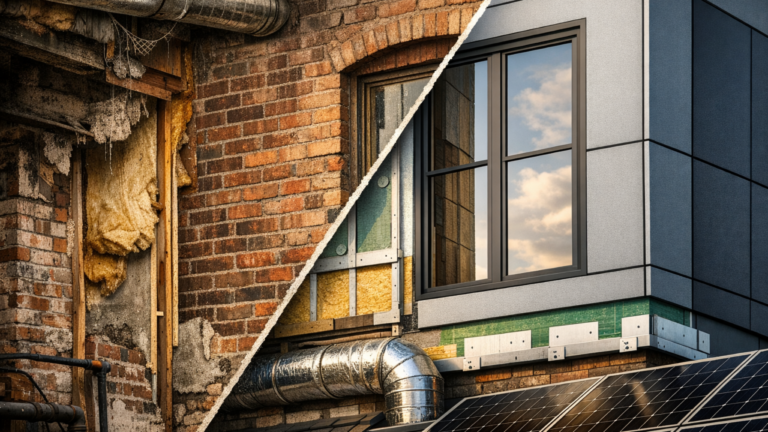
As energy codes tighten, many older high-rises are facing “Facade Retrofits.” A consultant evaluates if the building can be “re-skinned” while tenants are still inside—a complex logistical dance that is becoming more common as we strive for carbon neutrality.
Measurement, Tracking, and Evaluation
How do you prove a facade is performing? You need both “Leading” and “Lagging” indicators.
-
Leading Indicator (Predictive): Successful completion of the Performance Mock-up (PMU) and 100% “Pull Testing” of structural silicone in the factory.
-
Lagging Indicator (Reactive): Energy bills that match the predicted energy model; zero tenant “draft” complaints; thermographic drone scans that show no heat leaks.
-
Documentation: A “Facade Birth Certificate”—a digital log of every batch of glass and sealant used, providing a forensic trail for future owners.
Common Misconceptions and Oversimplifications
-
“Glass is a bad insulator.” Modern triple-glazed units with “Low-E” coatings can perform as well as some solid walls, provided the frames are thermally broken.
-
“The architect is responsible for the leaks.” In reality, the architect designs the look; the facade contractor and the consultant are responsible for the performance.
-
“Self-cleaning glass is a miracle.” It helps, but it still requires rain or rinsing to move the dirt. In arid climates, it does almost nothing.
-
“All silicone is the same.” There are structural silicones (which hold the glass on) and weather silicones (which keep water out). Swapping them is a common, and dangerous, site error.
Conclusion: The Ethics of the Envelope
In the final analysis, the pursuit of excellence in the vertical envelope is a matter of intellectual honesty. A high-rise facade is a promise made by the developer to the city and its inhabitants—a promise of safety, longevity, and efficiency. As we build higher, the margin for error disappears. The role of specialized technical guidance is not to add cost, but to ensure that this promise is kept.
A well-engineered facade is invisible; it works in the background, keeping the wind at bay and the energy inside. But a poorly engineered one is a permanent, visible failure. In an era where the environmental footprint of our cities is under intense scrutiny, the facade remains the most powerful tool we have for creating high-density, sustainable urban life. The future of the high-rise lies not just in how we support its weight, but in how intelligently we manage its skin.