How to Manage Facade Fading: An Editorial Guide to Color Preser
The visual degradation of a building’s exterior is often perceived as an inevitability of time—a slow, entropic drift toward desaturation. Yet, in the specialized field of architectural preservation and facade engineering, color permanence is understood as a quantifiable battle against solar radiation, atmospheric pollutants, and chemical instability. How to Manage Facade Fading. Facade fading is not merely a cosmetic grievance; it is a symptom of material fatigue that can signal the breakdown of protective resins, the oxidation of metallic finishes, or the structural weakening of composite substrates.
When a facade begins to lose its chromatic integrity, the implications ripple through the property’s lifecycle. For commercial assets, it represents a direct devaluation of brand identity and market perception. For residential structures, it can lead to increased thermal absorption, as lighter, faded surfaces may fail to reflect solar energy as efficiently as their original, engineered counterparts. The complexity of modern cladding—ranging from high-pressure laminates to PVDF-coated aluminum—means that there is no universal remedy for color loss.
Addressing this challenge requires a transition from reactive maintenance to a sophisticated, data-driven stewardship. Understanding the physics of the electromagnetic spectrum, particularly the destructive power of ultraviolet (UV) radiation on molecular bonds, is the first step toward effective intervention. This article serves as a comprehensive inquiry into the mechanisms of photodegradation and provides a strategic blueprint for asset managers and architects seeking to preserve the intended aesthetic of the built environment against the relentless pressure of the elements.
Understanding “how to manage facade fading”
The fundamental difficulty in how to manage facade fading lies in the distinction between surface accumulation (dirt) and structural degradation (pigment breakdown). Many property owners initiate cleaning protocols only to discover that the “film” they intended to remove was actually the sacrificial layer of the coating itself, now chalking and disintegrating. A multi-perspective explanation must account for the chemical nature of the finish: organic pigments, while vibrant, are inherently more susceptible to UV-induced scission than inorganic, mineral-based pigments.
A common misunderstanding is the belief that “fade-proof” materials exist. In reality, all materials occupy a position on a spectrum of lightfastness. Managing fading is therefore not about achieving stasis, but about controlling the delta—the rate of change over time. Oversimplification in this sector often leads to the application of topical sealants that are incompatible with the original substrate, resulting in “delamination” or “peeling” that is far more unsightly than the original fading.
The risks of an uncoordinated approach are significant. When a single elevation of a building is shaded by a neighboring structure while the others are exposed to direct southern light, the building will fade unevenly. If the management plan does not account for this “differential aging,” the building eventually takes on a disjointed, neglected appearance. Strategic management involves predicting these patterns before they manifest and adjusting maintenance cycles to harmonize the building’s overall visual coherence.
Deep Contextual Background: The Chemistry of Color
The history of architectural color is a history of transition from mineral stability to synthetic variety. Early civilizations relied on earth pigments—ochres, umbers, and oxides—which were essentially pre-oxidized and thus immune to further solar degradation. The transition to synthetic dyes and organic coatings in the 20th century expanded the architectural palette but introduced the modern problem of “photochemical oxidation.”
In the 1960s and 70s, the development of fluoropolymer coatings, such as Polyvinylidene Fluoride (PVDF), revolutionized facade design. These coatings use carbon-fluorine bonds, which are among the strongest in chemistry, to resist the energy levels of UV photons. However, the rise of “fast architecture” has seen an influx of lower-grade polyester and powder coatings that prioritize lower initial costs over molecular stability. This historical context is vital; it reminds us that current fading issues are often the direct result of a mid-century shift toward high-gloss, high-saturation synthetic finishes that were never designed for a century-long lifecycle.
Conceptual Frameworks and Mental Models
To analyze and mitigate color loss, one should apply the following frameworks:
1. The UV Exposure Budget
Think of a facade as having a limited “budget” of UV exposure before its molecular bonds fail. Every hour of direct southern exposure at high altitudes “spends” this budget faster than northern exposure in temperate climates. Management involves “saving” this budget through architectural shading or sacrificial coatings.
2. The Sacrificial Layer Theory
This model posits that it is better for a replaceable, inexpensive layer to fail than for the primary substrate to degrade. Modern clear-coats and waxes serve this purpose. The “mistake” in management is failing to replace the sacrificial layer before the UV reaches the “permanent” pigment below.
3. The Delta E (ΔE) Threshold
In the world of colorimetry, ΔE measures the distance between two colors. A ΔE of 1.0 is the smallest color difference the human eye can see. A robust management framework establishes a “Threshold of Intervention”—perhaps a ΔE of 5.0—where a full refinishing is triggered, preventing the building from reaching a state of perceived dereliction.
Material Categories and UV Resilience
Different materials require vastly different management strategies. The following table illustrates the trade-offs between initial aesthetic and long-term stability.
| Material Class | Pigment Type | UV Resistance | Primary Fading Mechanism |
| PVDF Coating | Inorganic | Exceptional | Gloss loss / Minimal color shift |
| Powder Coat | Mixed | Moderate | Chalking / Resin erosion |
| Anodized Aluminum | Electrolytic Dye | High | Pitting / Sealant failure |
| Fiber Cement | Acrylic/Latex | Low-Moderate | Pigment oxidation |
| Natural Wood | Lignin | Low | UV-induced bleaching |
| Terracotta | Vitrified Mineral | Exceptional | Virtually zero fading |
Realistic Decision Logic
If the building is located in a “High-UV Zone” (e.g., coastal Australia, Arizona, or high-altitude regions), the decision logic must bypass organic-pigment powder coats entirely. The capital expenditure of PVDF or pre-weathered metal is offset by the elimination of a mid-life repainting cycle.
Detailed Real-World Scenarios How to Manage Facade Fading
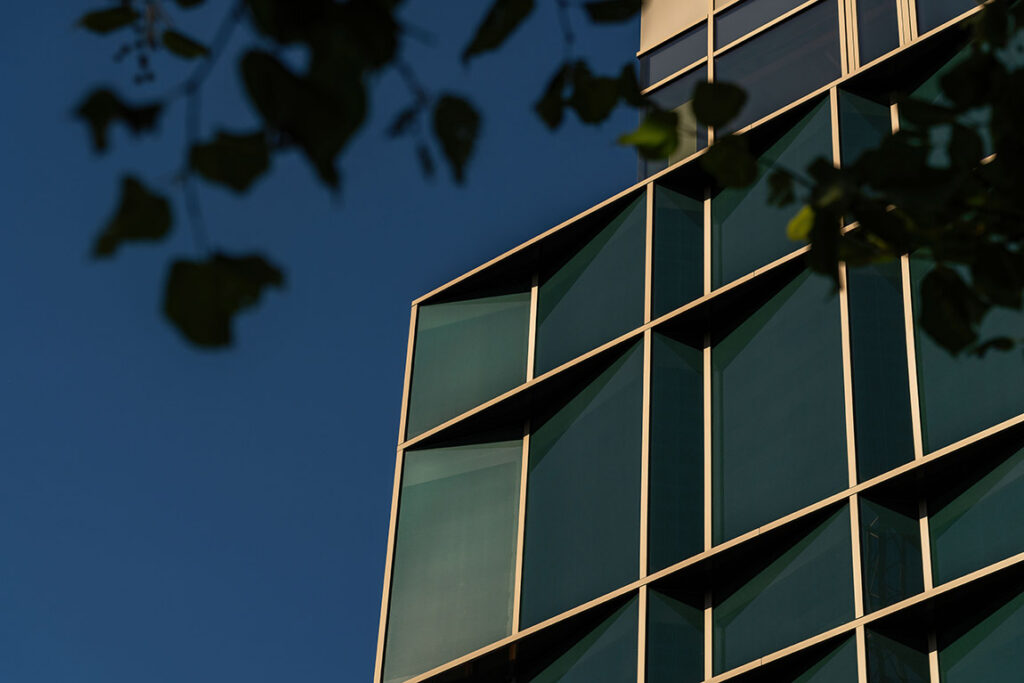
Scenario A: The High-Rise Reflective Glare
A building with a deep blue aluminum facade is located across from a new glass-heavy skyscraper.
-
The Problem: The glass building acts as a parabolic mirror, concentrating UV rays onto a specific section of the blue facade.
-
The Failure: That section fades 400% faster than the rest of the building.
-
Management Strategy: Apply a field-applied fluoropolymer clear-coat specifically to the “hotspot” elevation to extend its life until the next major renovation.
Scenario B: The “Chalking” Industrial Park
A series of warehouses were finished in a vibrant red polyester powder coat. After five years, they look pink and a white powder rubs off on one’s hand.
-
The Problem: Resin degradation. The white powder is the resin failing and exposing the pigment.
-
The Failure: Management tried to power-wash the building, which only stripped more of the remaining resin.
-
Management Strategy: Abrasive cleaning followed by a high-solids polyurethane restorer to “re-wet” the pigments and seal the surface.
Planning, Cost, and Resource Dynamics
The economics of how to manage facade fading are often hidden in the “soft costs” of building operation.
| Cost Element | Range of Impact | Mitigation Strategy |
| Initial Coating Grade | 5% – 15% of facade | Specify Kynar 500/Hylar 5000 resins |
| Access (Scaffolding) | 40% – 60% of repair | Design-in permanent roof anchors |
| Material Procurement | 10% – 20% of repair | Keep 2% “attic stock” of original panels |
| Climate Variability | Variable | Use UV-mapping software during design |
Opportunity Cost of Inaction
Fading is rarely linear. Once the protective top-coat is gone, the rate of fading accelerates. The cost of intervention at the “Chalking Stage” is approximately 20% of the cost of the “Substrate Damage Stage,” where the cladding itself must be replaced due to corrosion or moisture ingress.
Strategies and Support Systems for Color Preservation
-
Nano-Ceramic Coatings: These ultra-thin layers create a hydrophobic and UV-resistant barrier that can be applied to existing facades to “lock in” color.
-
UV Mapping and Simulation: Before construction, use solar-study software to predict which panels will receive the most radiation.
-
Pigment Tuning: Work with manufacturers to use only “Cool Pigments” that reflect Infrared (IR) as well as UV, reducing the thermal stress on the coating.
-
Field-Applied Fluoropolymers: For buildings already fading, high-end “air-dry” PVDF paints allow for professional-grade restoration without removing panels.
-
Automated Cleaning Systems: Regular removal of pollutants prevents “catalytic oxidation,” where dirt particles accelerate UV damage.
Risk Landscape and Failure Modes
The “Compounding Failure” of a faded facade often follows a specific taxonomy:
-
Gloss Failure: The finish becomes matte, making it more porous to pollutants.
-
Chalking: The resin breaks down into a white powder, which then runs down the building during rain, causing “tiger stripping” on windows.
-
Chromatic Shift: Blue turns grey; red turns pink.
-
Total Film Failure: The coating loses adhesion and flakes off, exposing the bare metal or substrate to oxidation.
Governance, Maintenance, and Long-Term Adaptation
A “Color Stewardship Plan” should be integrated into the building’s governance.
The Maintenance Review Cycle
-
Biannual: Qualitative visual inspection of all elevations at different times of day (noon and 4 PM).
-
5-Year: Quantitative colorimetric testing using a spectrophotometer on “control panels” in high-sun areas.
-
10-Year: Assessment of sealant integrity. Often, the fading of the sealant at the joints is the first sign that the main panels are next.
Measurement, Tracking, and Evaluation
A robust management program relies on empirical data rather than “eye-balling” the building.
-
Spectrophotometry: Measuring the exact wavelength of reflected light. This allows the manager to track ΔE over a decade.
-
Gloss Metering: Measuring the “specular gloss” at a 60-degree angle. A 50% drop in gloss is a leading indicator that fading is imminent.
-
Documentation: Maintain a “Facade Life-Log” containing the original “Master Color Plate” stored in a light-proof, temperature-controlled environment. This is the only way to prove a warranty claim for excessive fading.
Common Misconceptions and Oversimplifications
-
“Dark colors fade more than light colors.” Not necessarily. Dark colors absorb more heat, which can lead to thermal degradation, but a high-quality dark PVDF will outlast a cheap light polyester.
-
“Pressure washing fixes fading.” It actually accelerates it by removing the protective oxidized layer and exposing “fresh” pigment to UV before it’s ready.
-
“Anodizing never fades.” While the color is “grown” into the metal, the dyes used in some anodizing processes can still be susceptible to specific atmospheric acids.
-
“Warranties cover all fading.” Most warranties have a “crawling” clause where they only cover fading that exceeds a certain ΔE per year, which is often a very high bar to meet.
Ethical and Practical Considerations
There is an environmental cost to “managing” fading through frequent repainting. The VOCs (Volatile Organic Compounds) in field-applied coatings can be substantial. Therefore, the most ethical management strategy is “Durability by Design”—selecting materials that do not require chemical intervention for 30+ years. Furthermore, in urban environments, the “albedo effect” (the reflectivity of the facade) can influence the local “urban heat island.” Faded dark buildings that become lighter might actually reduce the building’s cooling load, presenting a rare case where degradation has a functional benefit.
Conclusion
To successfully how to manage facade fading is to accept that the building envelope is a sacrificial element in a high-energy environment. Mastery of this domain requires a shift from viewing the facade as a static image to seeing it as a chemical assembly in a state of constant flux. By employing quantitative tracking, prioritizing inorganic pigment stability, and intervening at the leading edge of resin degradation, owners can preserve the architectural intent of their structures indefinitely. The goal is not to stop time, but to ensure that when the building ages, it does so with a grace and consistency that speaks to a culture of deliberate stewardship.